Why Visibility Still Matters
On being LGBTQ+ and neurodivergent at work
I am a founder, I am autistic and I am gay. I realise this sounds like the start of a bad joke about a gay, autistic French founder walking into a bar, and to be fair I do walk into bars, although rarely the ones where founders go to network.
I have already written about being a founder and about being autistic. This piece is about being gay, and about what it is like to be all three at once.
I am writing it because I often hear that pieces like this are no longer needed: that the fight is over, that LGBTQ+ people are fine now, and that there is nothing left to ask for. Neither my own experience nor the numbers support that. Even in London, something as ordinary as holding a partner's hand in the street is not always safe, and a large share of LGBTQ+ and autistic people still hide who they are at work. As long as that is the case, I think those of us who are in a safe enough position should keep saying plainly who we are, including people like me who would naturally rather stay discreet.
I am not writing it as a confession or as a campaign. It is partly an explanation of why visibility still matters, and partly the practical information I would have liked to have when I was twenty.
A note on scope before I start: I am a gay man, so that is the experience I can speak from. Much of what follows applies across the LGBTQ+ community, and some of it is harder for others, trans people in particular.
Being both is common
For a long time I thought of being gay and being autistic as two unrelated facts about me, but they turn out to go together far more often than chance would suggest.
In the 2021 census, 28.8% of people in England and Wales who identified as lesbian, gay, bisexual or another minority sexual orientation were disabled, compared with 20.1% of the population as a whole. A Cambridge study published the same year found that autistic people were markedly less likely to identify as heterosexual than non-autistic people, although nobody fully understands why.
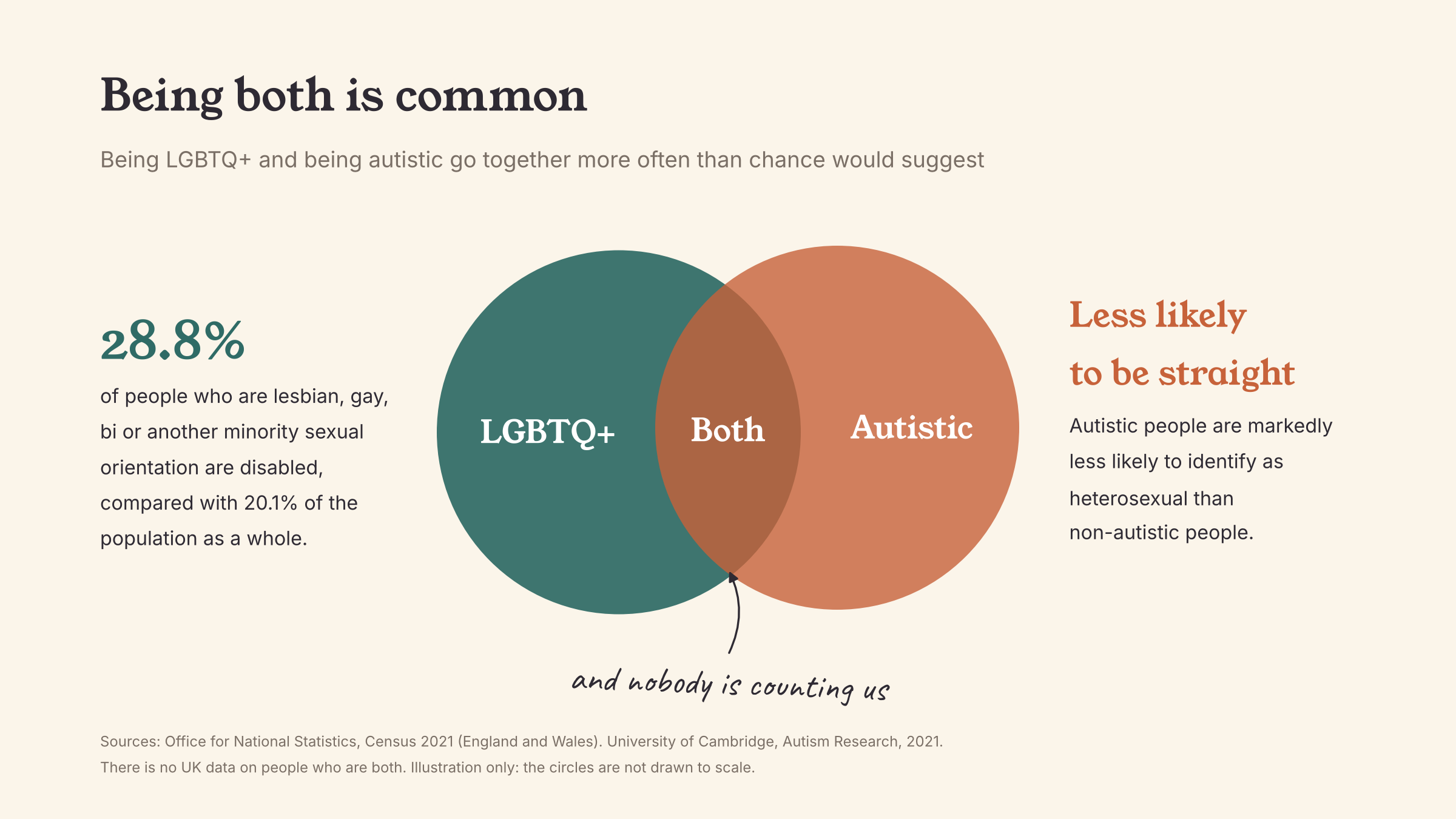
What this means in practice is that if you are both LGBTQ+ and autistic, you are not a statistical accident, and there are a lot more of us than you might think.
Many of us are still hiding one or the other
Autistic people often mask, which means rehearsing conversations, copying what seems to be expected and paying for it in energy afterwards. Many LGBTQ+ people do something similar that researchers call covering, where you are out but you play it down, for example by saying "my partner" and letting people fill in the rest.
Both habits are still common, even in the UK. At the end of October 2026 Stonewall published its first major report in almost a decade, in which 30% of lesbian, gay and bi people said they had hidden or disguised their sexual orientation at work in the past year, and 46% of trans people said they had hidden their gender identity. The government's Buckland Review found that only about 35% of autistic employees are fully open about being autistic at work, and in a 2024 survey of neurodivergent founders, 78% said they had hidden it in business situations.
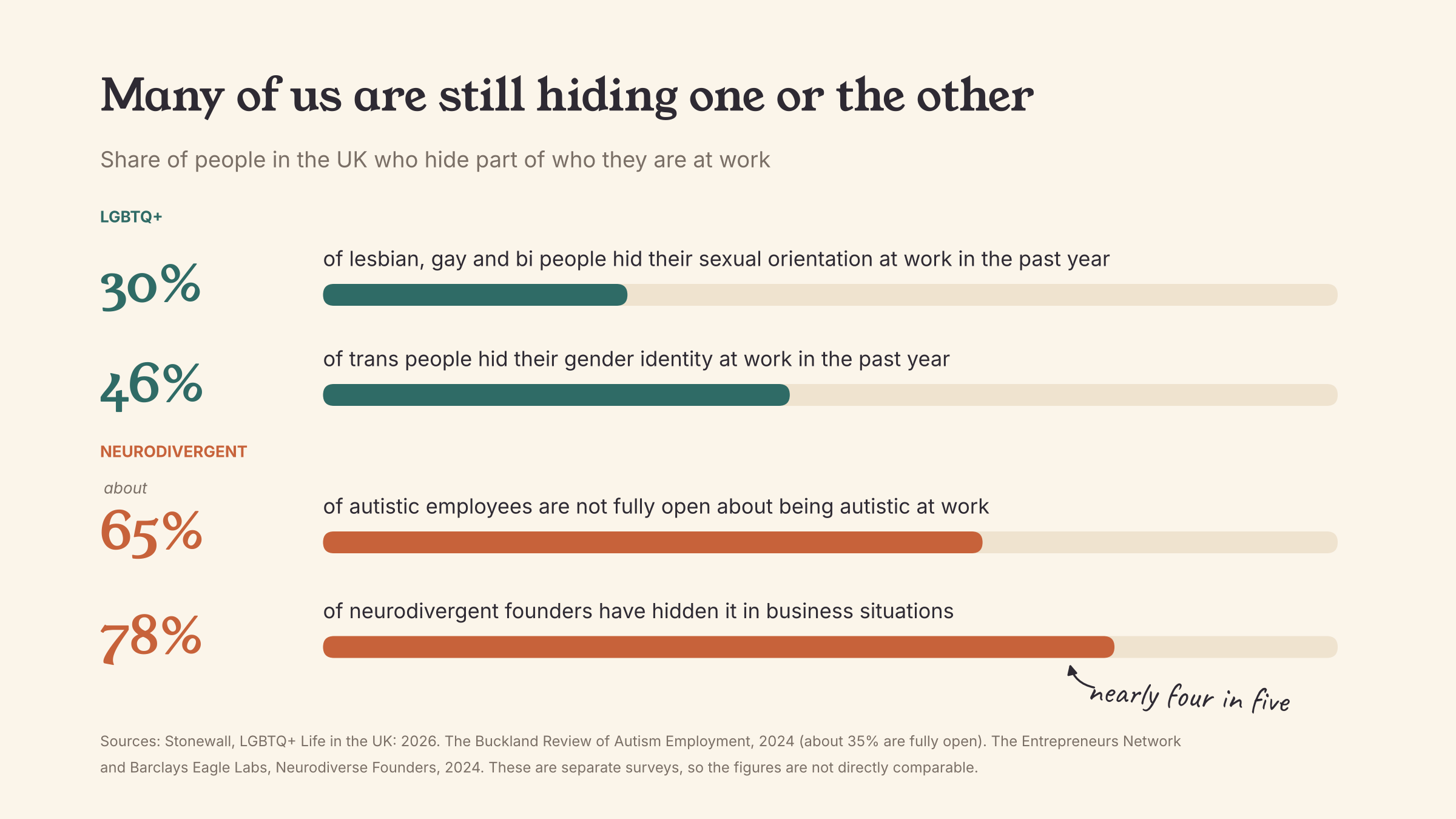
When you do both, the effort adds up. As far as I can tell, nobody has measured what that looks like for people who are both LGBTQ+ and autistic, because there is no data on us as a group.
I know what that effort costs. At times it felt as though I was living in a permanent lie, in which I had to be someone else, a straight, neurotypical version of myself. Having two things that could each be treated as a secret makes it stranger still, because you are constantly juggling them and scanning the room to work out what can be said and how you are supposed to behave, which is exhausting and can feel like an out-of-body experience.
At some point I started to challenge that and simply to be myself. I have found that being myself makes me much better, both for me and for the people around me, and that in turn makes the business better.
"Surely it is all fine now"
I said at the start that I often hear the fight is over. It usually comes with two other ideas: that LGBTQ+ people have become too visible, and that not being straight, or being autistic, has become something of a trend. I think all three are dangerous, and I would like to explain why.
I live in London, which is one of the easiest cities in the world to be gay in, and I still cannot hold my fiancé's hand in the street without occasionally being insulted, or worse. In practice this means that I usually do not, and that when I do, I feel anxious and afraid of what someone is going to say this time. My experience is not unusual. In the same Stonewall survey, fewer than half of LGBTQ+ people said they would feel comfortable holding their partner's hand in the street, and police in England and Wales recorded 21,407 hate crimes based on sexual orientation in the year to March 2026, which works out at almost 60 a day. That is the situation in one of the safer countries. In more than 60 others, according to the Human Dignity Trust, same-sex intimacy is still a crime.
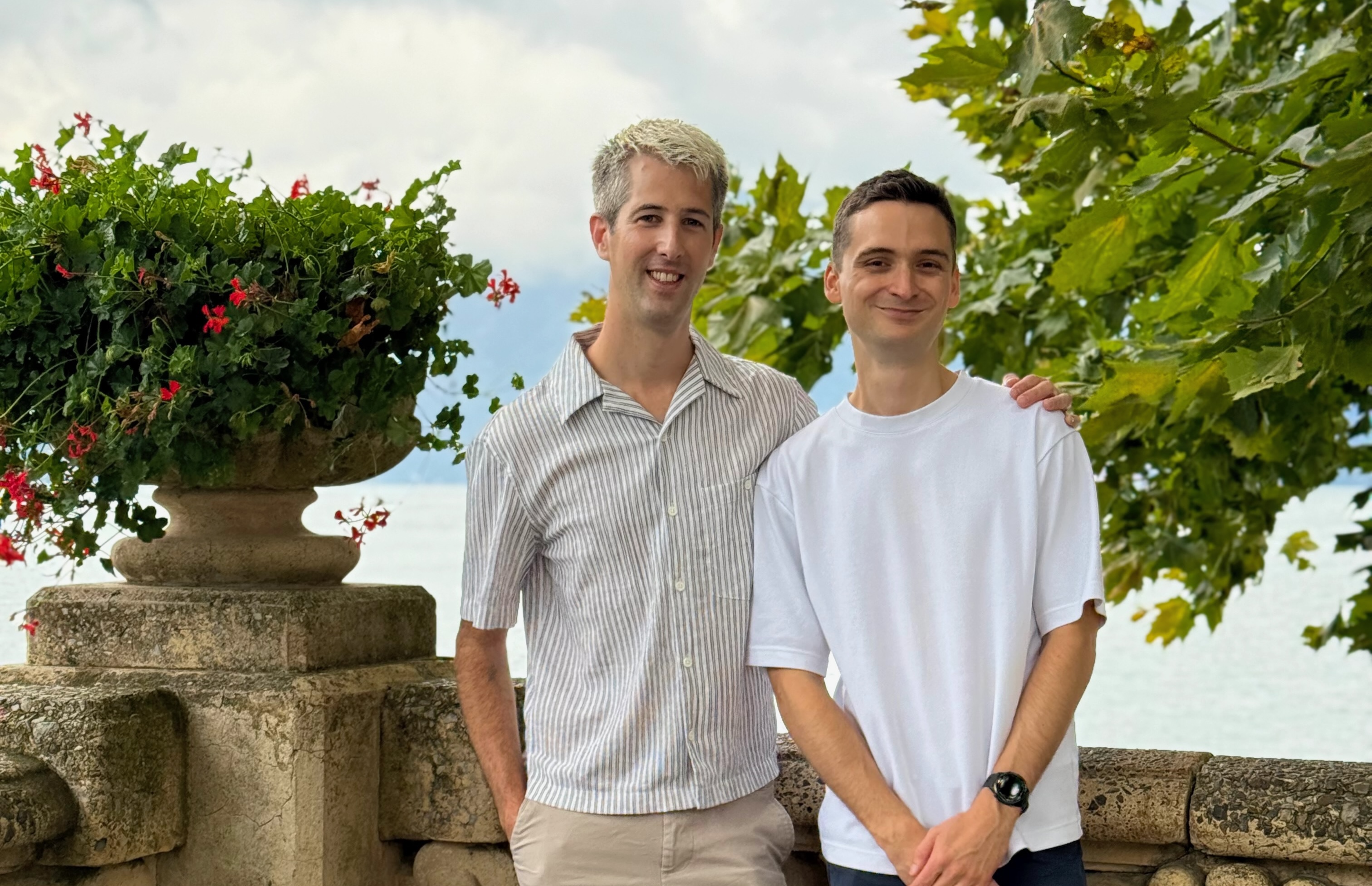
My fiancé, Louis, and me, in Italy. Standing side by side like this is about as much as we feel comfortable showing in public.
The result is that most of us learn to be careful, in a kind of unwritten "don't ask, don't tell". Holding hands or mentioning a partner are things straight people do without thinking, and would rightly call basic rights if anyone questioned them, but for us they are still small decisions that can be challenged at any moment. People who believe the fight is over rarely see that part.
The same reasoning applies to visibility. A march, a flag in a window or a colleague mentioning their husband can look excessive from the outside, but these things exist precisely because, for much of the time, many of us are quiet out of caution rather than choice. Being visible is how LGBTQ+ people keep a voice that is hard to ignore, and as long as holding hands in the street still carries a risk, that voice is needed.
As for the idea of a trend, being LGBTQ+ is not a trend and neither is being autistic. What has changed is that more people feel able to say it out loud. The share of young adults who say they are lesbian, gay or bi has risen, and the Office for National Statistics links that rise to society becoming more accepting. And when some people do say it loudly, it is usually because they have so often been told to be quiet before they had even spoken or done anything.
Discreet, and visible on purpose
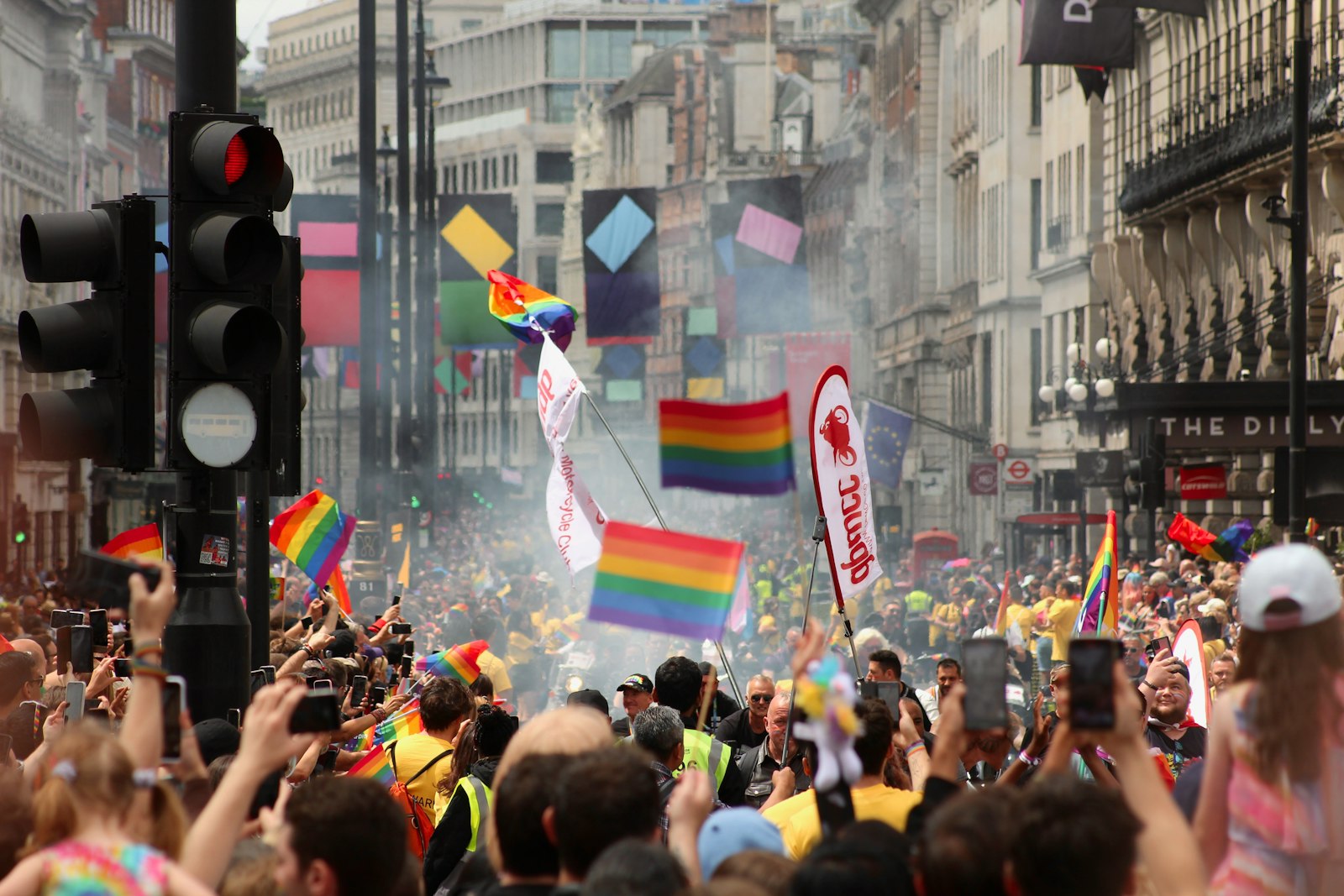
I am a discreet person by nature. At work I am the founder who stays in, I rarely post my private life, and I am not a very loud activist. That does not mean I hide. My way of being active is to show up: I like going out to bars and clubs, and I go to Pride, although I do not walk in the Pride parade.
None of that makes me any less proud of who I am, and it is exactly why I would never say that anyone is being too visible. The people who are willing to be loud are the reason people like me are able to be quiet.
There is also a real difference between being discreet by temperament and being discreet because you have no other option. My own discretion is partly temperament and partly, if I am honest, fear of being judged, but at work I at least get to choose, because I co-run the company and nobody there can make my life harder for it. Onepilot has more than 100 employees in several countries and works with more than 2,000 freelance agents in many more. Not all of them live somewhere it is safe to be open, at a time when new anti-LGBTI laws have been passed in several European countries in recent years, including some inside the EU.
That difference is what persuaded me that staying entirely quiet was not good enough, because when the people who are safe say nothing, the people who are not have nobody to point to.
So my own version of visibility is a small one, which is to say it plainly, in a place where it can be found. At Onepilot I do not hide it and I do not shout it. It is now written down as well.
Saying things plainly has worked better than I expected. After I wrote about autism, people wrote to me from all over the world, and they still do today, including colleagues, agents and people I had never met. One friend told me that the piece had helped them realise that, if they are autistic, it need not hold back their ambitions, and that what they have to do is make their career work for them. A colleague wrote that it had given them a great deal of hope for the future of their son, who is different, and that they finally understood why they had felt from the first day that they were in the right place. None of them wrote because of a campaign. They wrote because someone in a role they recognised had said something true about himself in plain words.
What has helped me
Saying it anyway. I do not shout about it, but I do say it. For a long time I tried not to mention it at all, and even today my first reaction is often a fear of being judged, which is physical and which I cannot simply switch off. What has changed is that I can now say it much more easily in spite of that fear, and once it is said I am able to stand up for it.
Changing the job instead of myself. I have held three roles at my own company, first as CTO, then in product and now in innovation. Each time, the job had drifted towards managing people and away from building, and changing my title turned out to be easier than rewiring myself, as well as better for the company. I am not unusual in this: in a survey of more than 600 neurodivergent founders published in June 2026, 76% said they had started a business in order to work in a way that suits them.
Treating recovery as a requirement. I need more rest than most people and I need routine, so I plan for both in the same way that I plan for meetings.
Finding people I feel safe with. Moving to London allowed me to meet other people from the LGBTQ+ community and to make friends with whom I feel safe. I do not need many such places, where I am a person and not a function, because the number matters much less than the quality, but having them has made a real difference.
If you run a company
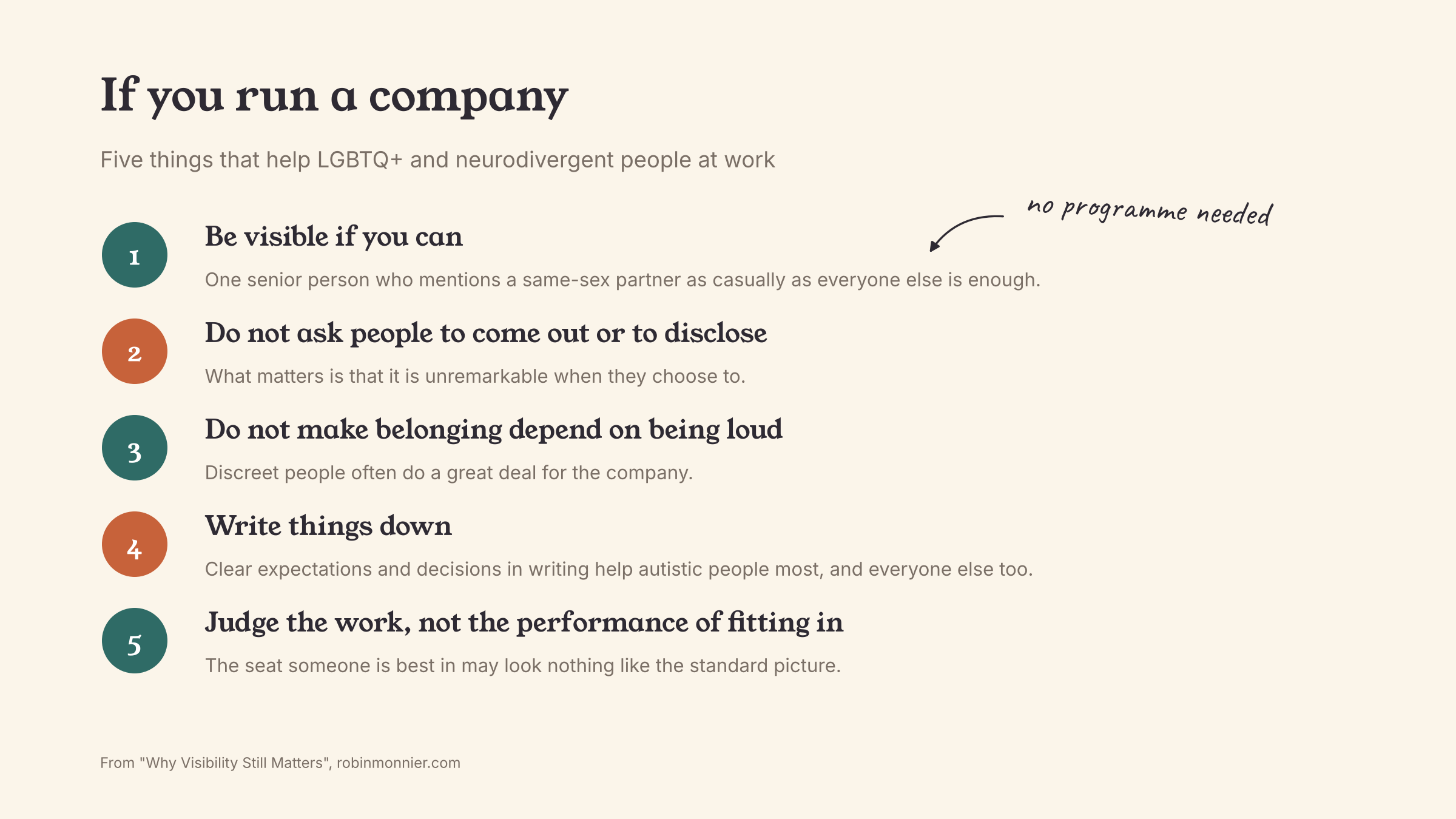
Be visible if you can. In Stonewall's 2026 survey, 30% of LGBTQ+ people said that seeing LGBTQ+ people in senior management mattered when they decided where to work, and one respondent described learning that their line manager was LGBTQ+ as a major reason for accepting the job. You do not need a programme for this, only one senior person who mentions a same-sex partner as casually as everyone else mentions theirs.
Do not ask people to come out or to disclose a diagnosis. What matters is that it is unremarkable when they choose to.
Do not make belonging depend on being loud. If the only way to be part of the team is to be loud, you overlook the discreet people who often do a great deal for the company, sometimes more than the loudest voices.
Write things down. Clear expectations, agendas and decisions in writing help autistic people most, but they help everyone else as well.
Judge the work, not the performance of fitting in. The seat I am best in looks nothing like the standard picture of a founder, and I only found it because my co-founders gave me the space to.
If you are LGBTQ+ and neurodivergent
You are not the only one and you are not an accident. You do not owe anyone your story, but if you are somewhere safe, saying it once can do more good than you would expect.
And if you ever see me at Pride, I will probably be standing at the side rather than walking in the parade, but I will be there, and very glad to be.
About the author
- Obsessed with turning complex operational chaos into scalable systems. At Onepilot, our AI-native platform and a network of 2,000+ independent freelancers run customer support for 300+ brands, handling millions of interactions a month, including the complex, multi-turn workflows traditional BPOs can't touch. Self-taught since age 12. Forbes 30 Under 30. 🚀 Scaling to $35M ARR and beyond. 🛠️ Building the future of automated business infrastructure.
Comments
Join the discussionNo comments yet. Be the first to comment.